An accessible unit is the right call whenever the public is invited or a worker may need it — public events, festivals, community park gatherings, road and utility projects on public right-of-way, and any site where…
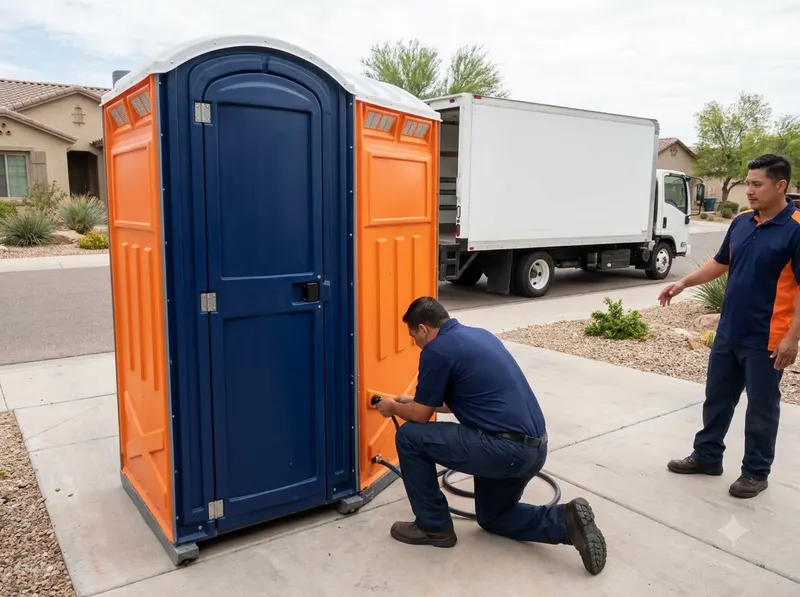
An accessible unit is the right call whenever the public is invited or a worker may need it — public events, festivals, community park gatherings, road and utility projects on public right-of-way, and any site where the restrooms are the only ones available. Federal accessibility guidance treats portable toilets grouped in a cluster as requiring at least one accessible unit in that cluster, generally around 5% of the total, so a 10-unit festival layout usually needs at least one accessible toilet placed in the same area as the rest — not tucked behind a fence a hundred yards away. That last part trips people up more than the count does: an accessible unit placed at the end of a gravel berm or across a curb is not usable, even though the unit itself is compliant. If your event is small and private — a backyard party in Augusta Ranch, a two-person remodel in Dobson Ranch — a standard unit is usually the sensible, cheaper choice, and the trade-off is simply footprint and cost.
Mesa's terrain drives most of our placement conversations. The hillside lots in Las Sendas and Mountain Bridge have grades and retaining walls that make finding a level pad the real work, and an accessible unit cannot sit on a slope — the door swing and the turning space stop functioning. On those jobs we look for a driveway apron, a flat pad near the street, or a spot where plywood or leveling can create a firm surface. Out in Eastmark, wide new streets and open community park space make drops straightforward, and the same is true around Superstition Springs parking lots and the flatter blocks of Alta Mesa and Red Mountain Ranch. In the Lehi area, soft irrigated ground and canal-bank access are the limiting factors, so we plan a firm approach rather than driving across turf. Sunland Village and other age-restricted neighborhoods often request an accessible unit even when the count doesn't require one, simply because a step-up entry is a barrier for residents using walkers.
Event work near Mesa Riverview, Sloan Park, and the Mesa Arts Center tends to have tight vendor windows and defined guest routes, so we ask where the accessible parking and the accessible path of travel are before choosing the drop point — the goal is a firm, level surface reached without curbs or steps. Trailhead and outdoor events near Usery Mountain Regional Park, along with pickups tied to boat-launch and shuttle staging for the Desert Belle at Saguaro Lake, need clearance for a full-size truck and a straight approach to the unit, since accessible models are too large to shuffle by hand once they're set. Summer heat in Maricopa County is the other planning factor: shade or an east-facing placement keeps the interior of a larger unit noticeably more tolerable, and multi-day events in June through September usually justify an added mid-run service visit.
Pricing on this service is a ballpark until we see the site. The variables that actually move the number are rental length, how many pump-out visits the schedule needs, how far the truck can get from the drop point, and whether the ground requires leveling. We confirm the exact price during a free on-site visit or after a short call describing access at your Mesa address — there's no charge for the walk-through and no obligation to book.
Every job gets a firm, written price after a free on-site visit.
Tell us about your ada-compliant portable toilet rental job in Mesa and we'll send a clear, written quote — usually the same day.
 Jessicas Portable Toilets